Upper Body Workout at Home: A Complete Beginner Guide
📋 Heather is an ISSA Certified Personal Trainer, not a doctor or medical professional. This article is for educational and motivational purposes only. Always check with your healthcare provider before starting a new fitness program.
Building upper body strength at home is more straightforward than most people think. You don’t need a gym, a cable machine, or a rack of dumbbells. A few well-chosen exercises, done consistently, will strengthen your chest, shoulders, back, and arms — and you can do all of it in your living room.
This guide covers everything you need for a complete upper body workout at home: the best exercises, how to structure them into a real routine, how many sets and reps to do, and how to keep progressing once the basics start to feel easy.
- Targets chest, shoulders, back, biceps, and triceps
- Works with bodyweight only or light dumbbells
- No gym, no machines, no complicated setup
- Every exercise includes a beginner modification
The best upper body workout is the one you can actually do consistently — and this one is designed to fit real life, not a fantasy schedule.

Why Upper Body Strength Matters
Upper body strength tends to get overlooked — especially by women who focus more on lower body or cardio training. But your upper body does a lot of daily work: carrying groceries, lifting children or grandchildren, reaching overhead, pushing and pulling, and maintaining good posture through hours of sitting and screen time.
- Stronger shoulders and back directly counteract the forward-rounded posture that comes from modern sedentary life.
- Upper body training supports a stronger core — your back and core work together constantly during movement.
- It makes everyday tasks noticeably easier within just a few weeks of consistent training.
- It does not make women “bulky” — it produces more toned arms, better posture, and genuine functional capability.
For more on the specific exercises that build this foundation, read Beginner Upper Body Exercises for Women at Home.
Equipment Options for Upper Body Training at Home
You have three tiers of equipment available, and all three work. Start with what you have — you can always add from there.
- No equipment: Wall push-ups, floor push-ups, tricep dips on a chair, and doorframe rows give you a complete upper body workout with zero cost.
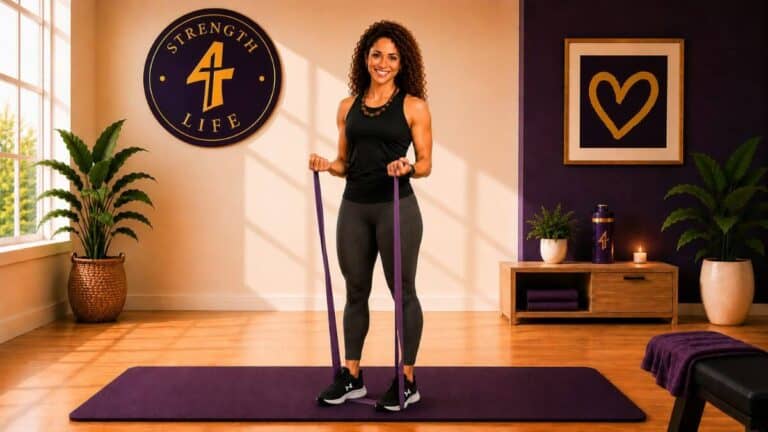
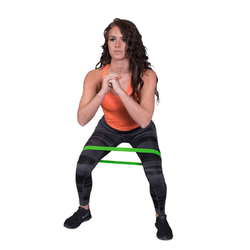
- Resistance bands: A light set opens up banded rows, shoulder presses, and bicep curls — adding real resistance without the space or cost of dumbbells.
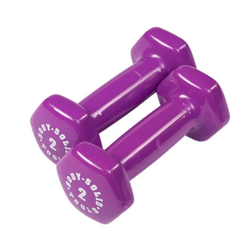
- Light dumbbells: A single pair of 5–10 pound dumbbells covers virtually every exercise in this guide. Adjustable dumbbells are the most versatile single investment you can make.
The Best Upper Body Exercises for Home Workouts
These six exercises cover all the major upper body muscle groups — chest, shoulders, back, biceps, and triceps — with beginner modifications for every one.
1. Push-Ups (Chest, Shoulders, Triceps)
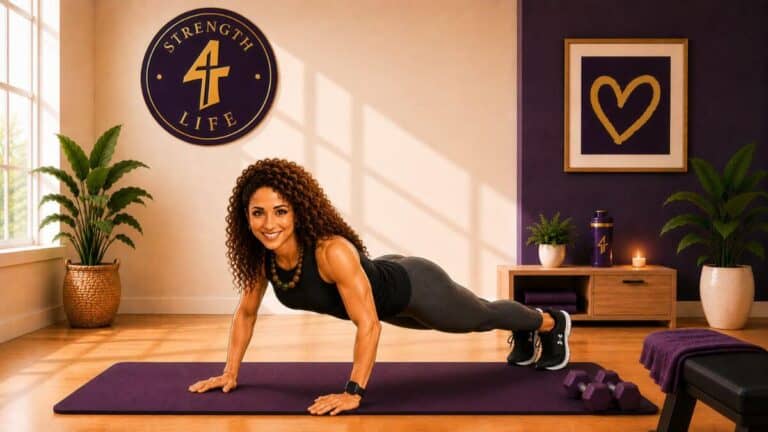
The single best upper body exercise without equipment. Hands slightly wider than shoulder-width, body in a straight line, lower chest toward the floor and press back up. Elbows stay at roughly 45 degrees from your sides throughout.
- Sets and reps: 3 × 8–12
- Modification: Wall or incline push-ups on a countertop — the higher the surface, the easier.
- Progression: Slow the lowering phase to 3 seconds for more challenge without changing anything else.
2. Dumbbell or Band Rows (Back, Biceps)
The most important exercise for most women — builds the back strength that directly corrects rounded posture. Hinge slightly forward at the hips, pull the weights toward your hips leading with your elbows, lower slowly. Keep your back flat throughout.
- Sets and reps: 3 × 10–12
- Modification: Supported single-arm row with one hand on a chair, or a doorframe row with bodyweight only.
- Key cue: Lead with your elbow, not your hand.
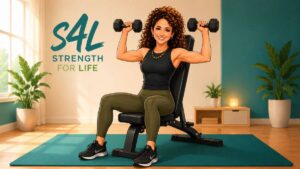
3. Shoulder Press (Shoulders, Triceps)
Pressing overhead builds shoulder strength and trains the pattern of lifting things above your head. Hold dumbbells or a band at shoulder height, palms forward, press overhead until arms extend, lower with control.
- Sets and reps: 3 × 10–12
- Key cue: Keep your core braced — avoid arching your lower back as you press.
- Modification: Start lighter than you think you need. The shoulder joint is more sensitive than the chest or back.
4. Bicep Curls (Biceps)
Curls directly strengthen the front of the arm and train the pattern of lifting things toward you. Elbows pinned to your sides, curl weights toward shoulders, lower slowly with control.
- Sets and reps: 3 × 10–12
- Key cue: Keep elbows pinned throughout — swinging them forward turns this into a shoulder exercise.
5. Tricep Dips (Triceps)
Sit on the edge of a sturdy chair, hands gripping the seat. Slide hips forward off the seat, lower by bending elbows to about 90 degrees, press back up.
- Sets and reps: 2–3 × 8–10
- Modification: Feet closer to the chair with knees bent reduces the load significantly.
6. Lateral Raises (Shoulders)
Targets the side of the shoulder — missed by most pushing and pulling exercises. With a slight bend in the elbows, raise both arms out to the sides to shoulder height. Lower slowly.
- Sets and reps: 2–3 × 12–15
- Key cue: Use lighter weight than expected — this is a smaller muscle and easy to overload.
Upper Body Workout at Home — No Equipment Version
If you have zero equipment, here’s a bodyweight-only version that still hits all the major upper body muscles. This is a great starting point before adding any resistance.

- Wall or Incline Push-Ups — 3 × 10–15, adjust surface height to your level
- Doorframe Rows — 3 × 8–10, grip doorframe at chest height, lean back and pull
- Tricep Dips on Chair — 2–3 × 8–10, knees bent for easier, legs extended for harder
- Pike Push-Ups — 2 × 8–10, hips high in an inverted V shape, lower head toward floor (bodyweight shoulder press substitute)
Read: Bodyweight Exercises for Women: A Complete Home Workout Guide
How to Progress Over Time
Once the workout starts feeling more manageable than challenging, make one small adjustment at a time — don’t change everything at once.
- Add 2 reps to each set before adding weight
- Increase dumbbell weight by the smallest available increment
- Slow down the lowering phase to 3 seconds for significantly more challenge
- Reduce rest time between sets slightly
- Add a fourth set to the exercises that feel easiest first
One small progression per week is enough to keep making real gains without risking overuse or burnout.
A Complete Upper Body Home Workout
Here’s the full routine in one place. Approximately 30–35 minutes with normal rest periods. Do exercises in this order — compound movements first while you’re freshest, isolation exercises at the end.
| Exercise Push-Ups (wall, incline, or floor) | Sets × Reps 3 × 8–12 | Rest 60 sec |
| Exercise Dumbbell or Band Rows | Sets × Reps 3 × 10–12 | Rest 60 sec |
| Exercise Shoulder Press | Sets × Reps 3 × 10–12 | Rest 60 sec |
| Exercise Bicep Curls | Sets × Reps 3 × 10–12 | Rest 45 sec |
| Exercise Tricep Dips | Sets × Reps 2–3 × 8–10 | Rest 45 sec |
| Exercise Lateral Raises | Sets × Reps 2–3 × 12–15 | Rest 45 sec |
How Often Should You Train Upper Body at Home?
Two to three times per week with at least one rest day between sessions. Upper body muscles typically recover in 48–72 hours — spacing sessions out lets your muscles rebuild stronger than they were before the workout. Alternating upper and lower body days is one of the most efficient structures for training your whole body without overlap.
Start with two sessions a week, stay consistent for a month, and add a third day once the routine feels manageable rather than overwhelming.
Want a Complete Program That Puts It All Together?
Inside Strength for Life, I help women build real upper body and full-body strength at home with beginner-friendly workouts designed for real life — no gym, no guesswork, no complicated programming.
- Done-for-you workouts including upper body, lower body, and full-body options
- Progressive programming that builds on itself week over week
- Home-friendly routines under 40 minutes
- Supportive coaching from a certified trainer
Frequently Asked Questions About Upper Body Workouts at Home
Yes. Push-ups, rows, and presses build genuine upper body strength regardless of whether you’re in a gym or your living room. The equipment is a tool — the movement is what builds the muscle.
Most women notice improved strength and easier movement within two to three weeks of consistent training. Visible changes in arm and shoulder tone typically become noticeable around the six to eight week mark.
For most women, no. Strength training the upper body tends to produce a more toned, defined appearance rather than visibly larger muscles. Building significant muscle mass requires very high training volumes and a calorie surplus that a standard home workout doesn’t provide.
Most beginners do well starting with 5–8 pounds for shoulder exercises and lateral raises, and 8–12 pounds for rows and bicep curls. Choose a weight where the last two or three reps feel genuinely challenging but still controlled.
Two to three days per week with rest days in between is ideal. That frequency provides enough stimulus to build strength while allowing adequate recovery between sessions.
You can, but most beginners find it easier and more sustainable to alternate upper and lower body days. That way each session is focused and manageable rather than a lengthy full-body effort.
Build Your Home Workout Routine
 Step 1
 Step 2
 Step 3
 Step 4
 Step 5
Ready to put this into action?
💪 Start Your Free 7-Day Trial
Free Home Workout Starter Guide
Download your free PDF and start building strength today.
- 3 beginner-friendly routines
- No equipment needed
- Just 20 minutes a day
Enter your email to download