Beginner Strength Training for Women: Complete Guide
📋 Heather is an ISSA Certified Personal Trainer, not a doctor or medical professional. This article is for educational and motivational purposes only. Always check with your healthcare provider before starting a new fitness program.
If you are new to strength training, or coming back after a long break, it is easy to feel unsure about where to begin. You may wonder what exercises to do, how often to work out, what weights to use, or whether you are already too out of shape to start.
Let me say this clearly: you do not need to be strong before you start strength training. You get stronger by starting where you are and building from there.
Beginner strength training for women should feel simple, supportive, and realistic. It should help you build confidence, not make you feel intimidated. You do not need a gym. You do not need heavy weights. You do not need a complicated plan.
- You can start at home.
- You can use bodyweight exercises or light dumbbells.
- You can train two or three days per week.
- You can build strength without beating up your body.
The CDC recommends adults include muscle-strengthening activity at least two days per week. You do not need to do everything at once — you can build slowly and still make real progress.

What Is Strength Training?
Strength training means using your muscles against resistance. That resistance can come from your own bodyweight, dumbbells, resistance bands, kettlebells, or even household items when you are just starting out.
The goal is to challenge your muscles so they adapt and become stronger over time. You do not need to lift heavy weights on day one. Most beginners should start with simple movements and focus on good form first — weight comes later.
- Squats strengthen your legs and glutes.
- Rows strengthen your back and arms.
- Push-ups strengthen your chest, shoulders, and arms.
- Glute bridges strengthen your hips and posterior chain.
- Core exercises support balance, posture, and stability.
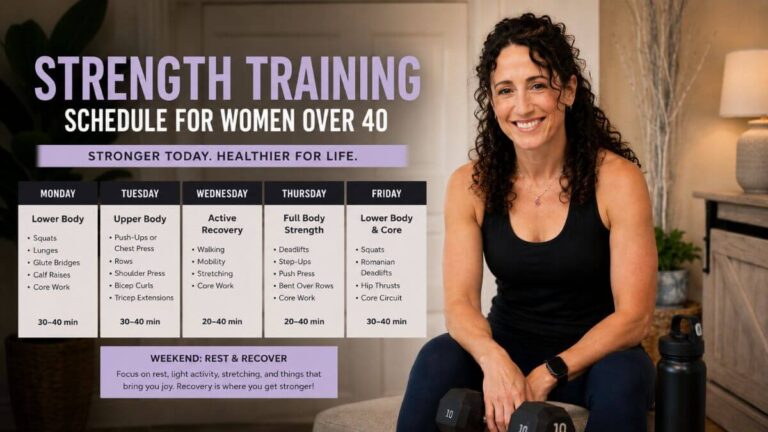
If you want a ready-made weekly plan, read The Best Strength Training Plan for Women Over 40.
If you don’t have any equipment yet, this No-Equipment Workout for Women at Home gives you a complete bodyweight-only routine to start with right away.
Why Strength Training Matters for Women
Many women start with cardio because it feels familiar — walking, cycling, and low-impact cardio are all helpful. But strength training gives your body a different kind of support that cardio alone cannot provide.

Stronger muscles make daily life easier — carrying groceries, lifting laundry, getting up from a chair, climbing stairs, and moving with confidence all require strength you build in the gym or at home.
- Supports posture and reduces upper back tension.
- Makes everyday tasks feel noticeably easier.
- Supports muscle mass and bone density as you age.
- Builds physical confidence that carries into everyday life.
How Often Should Beginners Strength Train?
Most beginners do well with two or three strength workouts per week. That gives your body enough practice to improve while still leaving time for recovery — which is where the actual strength gains happen.
A simple starting framework:
- Beginner: 2 strength workouts per week
- Building consistency: 2–3 strength workouts per week
- More experienced: 3–4 strength workouts per week
If you are brand new, start with two days. After a few weeks, add a third day if your body feels ready. Recovery matters — more is not always better if your body cannot keep up with it.
For a very simple starting point, read: Simple Strength Plan for Women Over 40
The Best Beginner Strength Exercises for Women
A good beginner workout covers the major movement patterns your body uses in everyday life — squat, push, pull, hinge, and stabilize. These six exercises cover all of them.
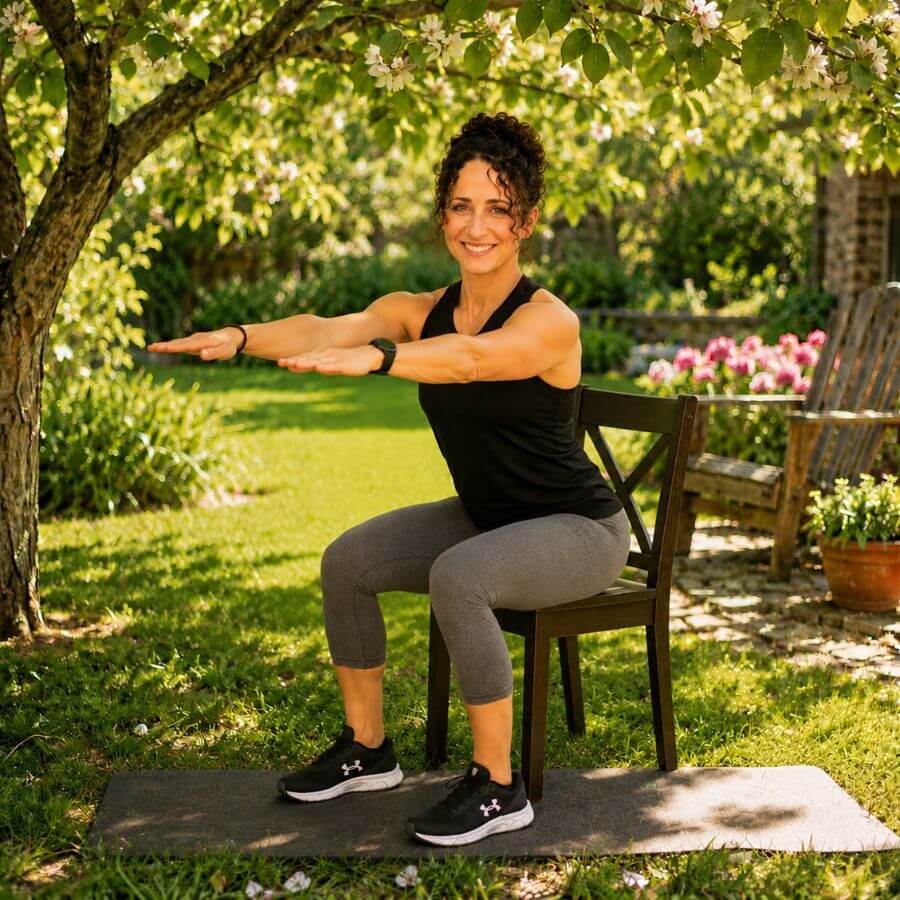
- Chair Squats: Trains legs, glutes, and the sit-to-stand movement pattern.
- Wall Push-Ups: Beginner-friendly chest, shoulder, and arm strength.
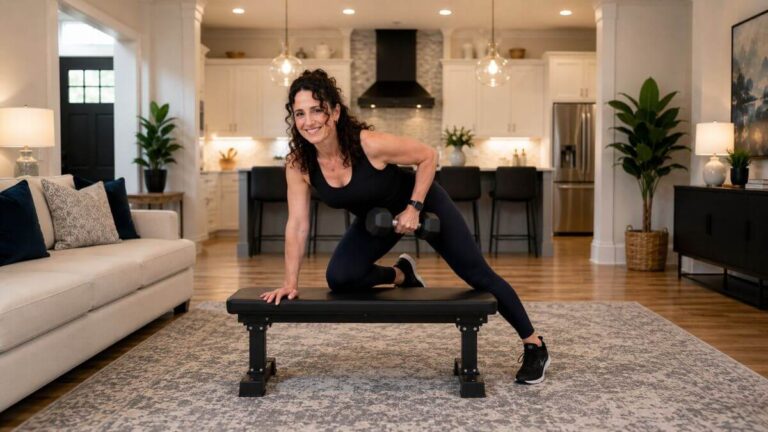
- Dumbbell Rows: Upper back strength and posture support.
- Glute Bridges: Hip and glute strength with zero knee stress.
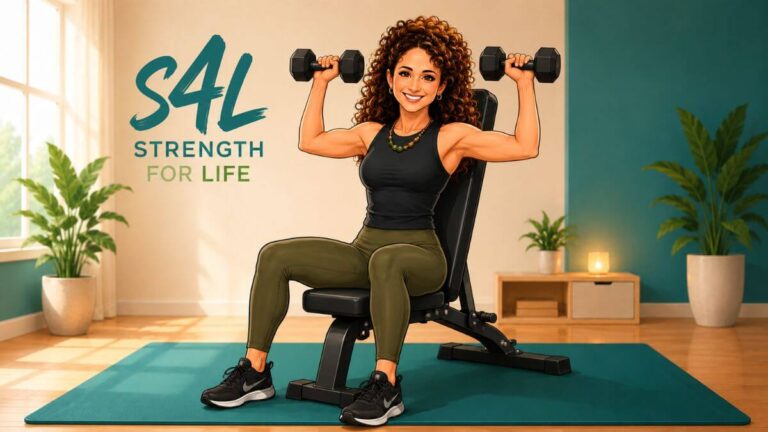
- Shoulder Press: Overhead strength with light dumbbells.
- Dead Bug: Deep core stability without straining the neck or back.
A Complete Beginner Strength Training Workout
Here is a simple full-body workout you can do at home. Start with 2 sets if you are brand new. Build toward 3 sets as your strength and confidence improve.
| Exercise Chair Squats | Sets × Reps 2–3 × 8–12 | Tip Lower until you touch the seat |
| Exercise Wall Push-Ups | Sets × Reps 2–3 × 8–12 | Tip Keep body in a straight line |
| Exercise Dumbbell Rows | Sets × Reps 2–3 × 8–12 per side | Tip Lead with elbow, not hand |
| Exercise Glute Bridges | Sets × Reps 2–3 × 10–15 | Tip Squeeze glutes at the top |
| Exercise Standing Marches | Sets × Reps 2 × 30–45 sec | Tip Hold counter for balance if needed |
| Exercise Dead Bug | Sets × Reps 2 × 6–10 per side | Tip Keep lower back pressed to floor |
Rest 45–60 seconds between sets. Use light weights. Move slowly and with control. The goal is to finish feeling successful enough to come back again.
For upper body help, read: Beginner Upper Body Exercises for Women at Home
Beginner Weekly Strength Training Schedule
This schedule gives you strength training, movement, and recovery without making fitness feel like a second job.
| Monday Full-body strength workout | Tuesday Walk or gentle mobility | Wednesday Rest or stretching |
| Thursday Full-body strength workout | Friday Low-impact cardio or walk | Weekend Optional movement or recovery |
For a broader weekly layout with three strength days, read Balanced Weekly Workout Plan for Women Over 40.
How Much Weight Should Beginners Use?
Start lighter than you think you need to. In the beginning the goal is learning control, posture, breathing, and movement — not lifting as heavy as possible.
The right weight should feel challenging by the last few reps, but you should still be able to move with good form throughout the set.
- If you are swinging the weight, it is too heavy.
- If your posture collapses, go lighter.
- If the last few reps feel challenging but controlled, you are in a good range.
- If you are unsure, start with bodyweight or very light dumbbells.
What you eat also plays a real role in how your body responds to training — read: Good Nutrition and Why It Matters for Energy and Results.
Most women start with 3, 5, 8, or 10 pound dumbbells depending on the exercise — and make real progress from there.
What If You Are Starting Again After a Long Break?
Starting again can feel emotional. You may remember what you used to do and feel frustrated by where you are now. That is completely normal — and it does not mean you should give up or wait until you feel more ready.
Give yourself permission to begin again without punishment. Your first goal is not to prove anything. Your first goal is to build trust with yourself — one workout at a time.
- Start with shorter workouts — 15–20 minutes is enough.
- Use easier exercise versions and lighter weights.
- Take more rest between sets if needed.
- Repeat the same routine for several weeks before changing anything.
If this sounds like you, read: How to Start Working Out Again After a Long Break
Common Beginner Strength Training Mistakes
Most beginners do not fail because they are lazy. They struggle because the plan is too much, too soon, or too confusing to stick with.
- Doing too much too soon: Start with a plan your body can actually recover from.
- Changing workouts constantly: Repeat the same exercises long enough to improve at them.
- Skipping rest days: Recovery is when your body actually gets stronger.
- Using poor form: Control matters more than speed or weight.
- Quitting after a missed week: Just return to the next workout — no drama, no starting over.
Part of showing up consistently is being willing to push past the days you do not feel like it — read: Why Working Hard Matters in Fitness.
If consistency is your biggest challenge, read How to Stay Consistent With Exercise When You’re Tired, Busy, and Overwhelmed.
How to Know If You Are Getting Stronger
Progress is not only about the scale. Strength progress shows up in small, practical ways that matter just as much — sometimes more.
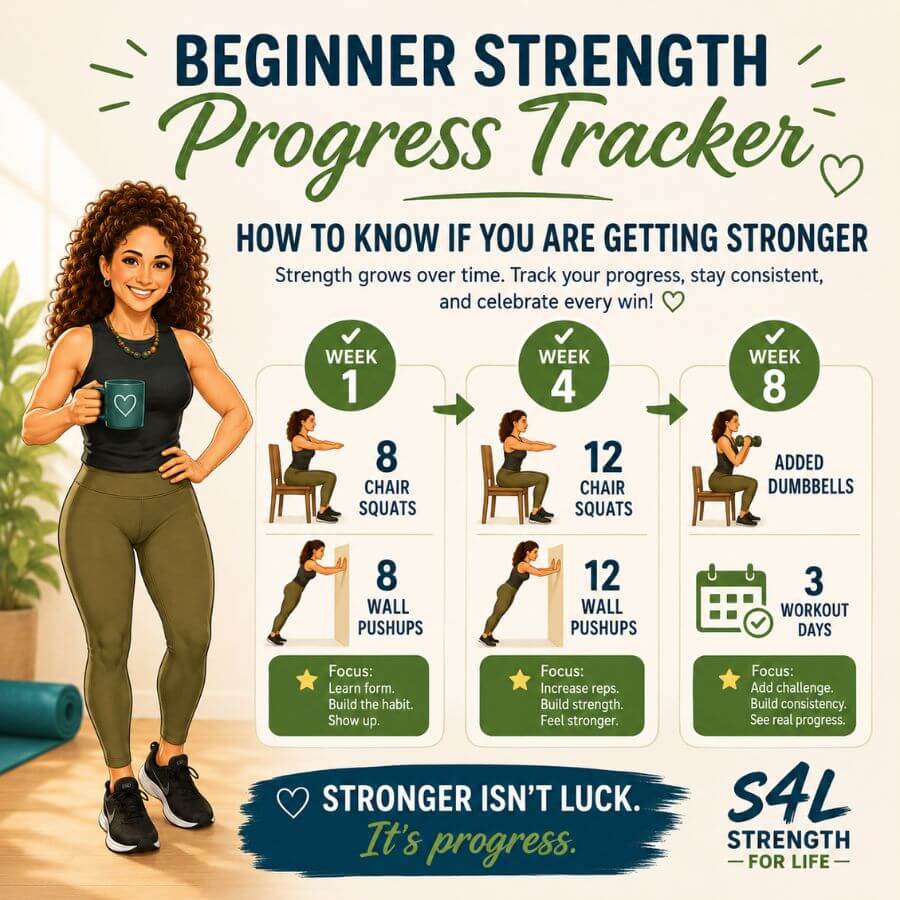
- You can do more reps with good form than last week.
- The same weight feels easier than it used to.
- You recover faster after workouts.
- Daily tasks feel less tiring and more manageable.
- Your posture feels more upright and controlled.
- You feel more confident walking into each workout.
Write down your workouts if you can. A simple note on your phone is enough. Tracking helps you see progress you might otherwise miss — especially in the early weeks when changes are subtle.
Final Thoughts
Beginner strength training for women does not need to be complicated.
Start with simple exercises, repeat them consistently, and let your strength build one workout at a time.
You do not need to be perfect. You just need to begin, adjust, and keep coming back.
For help structuring your week, read: A Realistic Strength Training Schedule for Women Over 40
Want Simple Strength Workouts You Can Do at Home?
Strength 4 Life helps women build strength with realistic home workouts that are clear, supportive, and beginner-friendly — no gym, no complicated programming, no guesswork.
- Beginner-friendly strength workouts
- Low-impact options for sensitive joints
- Simple weekly structure that progresses with you
- Supportive guidance that fits real life
Wondering if this actually works for building real, visible muscle at this age? Can Women Build Muscle After 40? breaks down exactly what to expect and how long it takes.
Frequently Asked Questions
Start with simple full-body workouts two days per week. Use bodyweight exercises or light dumbbells, focus on good form, and build slowly over several weeks before increasing weight or frequency.
Two days per week is a great starting point. Many beginners build toward three strength workouts per week after the first month once recovery and consistency feel manageable.
Yes. Every exercise in this guide can be done at home using bodyweight movements, light dumbbells, or resistance bands. No gym membership required.
No. Beginner strength training builds functional strength, muscle tone, and confidence — not bulk. Women do not produce enough testosterone to build large muscles easily, and the training required to get bulky looks nothing like a beginner routine.
Most women notice improved energy and better movement within 2–3 weeks. More visible strength and body composition changes typically show up around weeks 6–8 with consistent training.
Beginner Strength Training Resources



Continue Your Strength Journey
 Step 1
 Step 2
 Step 3
 Step 4
 Step 5
Ready to put this into action?
💪 Start Your Free 7-Day Trial
Free Home Workout Starter Guide
Download your free PDF and start building strength today.
- 3 beginner-friendly routines
- No equipment needed
- Just 20 minutes a day
Enter your email to download