Best Low-Impact Cardio Exercises for Women Over 40
📋 Heather is an ISSA Certified Personal Trainer, not a doctor or medical professional. This article is for educational and motivational purposes only. Always check with your healthcare provider before starting a new fitness program.
Cardio does not have to mean jumping, running, burpees, or beating up your knees. If you are a woman over 40, low-impact cardio can be one of the best ways to build endurance, support your heart, improve energy, and feel better in your body — without feeling like your workout is punishing you.
Low-impact simply means at least one foot stays on the ground most of the time, or the movement is gentler on your joints. You can still sweat. You can still raise your heart rate. You can still get fitter and stronger. You just do it in a way that feels more realistic for your body and your season of life.
- Low-impact cardio is easier on the knees, hips, ankles, and lower back.
- It can be beginner-friendly and still genuinely effective.
- It works exceptionally well paired with strength training for women over 40.
- It is sustainable enough to do consistently — which is what actually produces results.
The CDC recommends adults aim for at least 150 minutes of moderate-intensity activity per week alongside 2 days of strength training. You can break that into shorter sessions and build from wherever you are starting.

Why Low-Impact Cardio Works So Well After 40
After 40, many women notice changes in energy, recovery time, joint comfort, sleep quality, and weight management. That does not mean your best fitness years are behind you — it means your workouts need to support your body instead of constantly drain it.
Low-impact cardio is helpful because it gives your heart and lungs meaningful work to do without adding pounding and impact stress to your joints. This is especially useful if you are returning to exercise after a break, dealing with knee or hip sensitivity, or simply tired of workouts that feel aggressive and unsustainable.
- Improves stamina and endurance for daily life activities.
- Supports weight management when paired with strength training and good nutrition.
- Reduces stress and improves mood through consistent movement.
- Easy enough to repeat regularly — which is the real secret to results.
If you are already doing strength workouts, low-impact cardio is the perfect partner — it builds conditioning without interfering with your strength progress. For more on combining both, read Strength Training vs Cardio for Women: What Actually Helps?
1. Brisk Walking
Walking is simple — but do not underestimate it. A brisk walk raises your heart rate, improves endurance, supports mental clarity, and contributes meaningfully to your weekly activity goals. It also requires zero equipment and can be done anywhere.

To make walking more effective, aim for a pace where you can still talk but would not want to sing. Keep your shoulders relaxed, swing your arms naturally, and take steady, purposeful steps.
Duration: Start with 10–15 minutes and build toward 20–30 minutes.
- Start with 10–15 minutes if you are new to exercise.
- Build toward 20–30 minutes as endurance improves.
- Add gentle hills or short faster intervals when you feel ready.
2. Step Touches and Side Steps
Step touches are one of the best low-impact cardio moves for beginners because they are easy to learn, easy to modify, and require no equipment or much space. They work well as a standalone cardio session or as a warm-up before strength training.
How to do it:
- Stand tall with soft, slightly bent knees.
- Step your right foot out to the side.
- Bring your left foot in to meet it.
- Repeat side to side at a comfortable rhythm.
- Add arm reaches overhead or out to the sides when ready.
Duration: 30–60 seconds per set, 3–5 sets. Rest as needed between sets.
To increase intensity, bend the knees more, speed up the pace, or add light hand weights. To reduce intensity, slow down and keep the arms low.
3. Marching in Place
Marching in place is one of those exercises that looks basic but is genuinely useful — especially for women returning to exercise or working out in a small space. It warms up the body, raises the heart rate, and builds coordination without any joint impact.
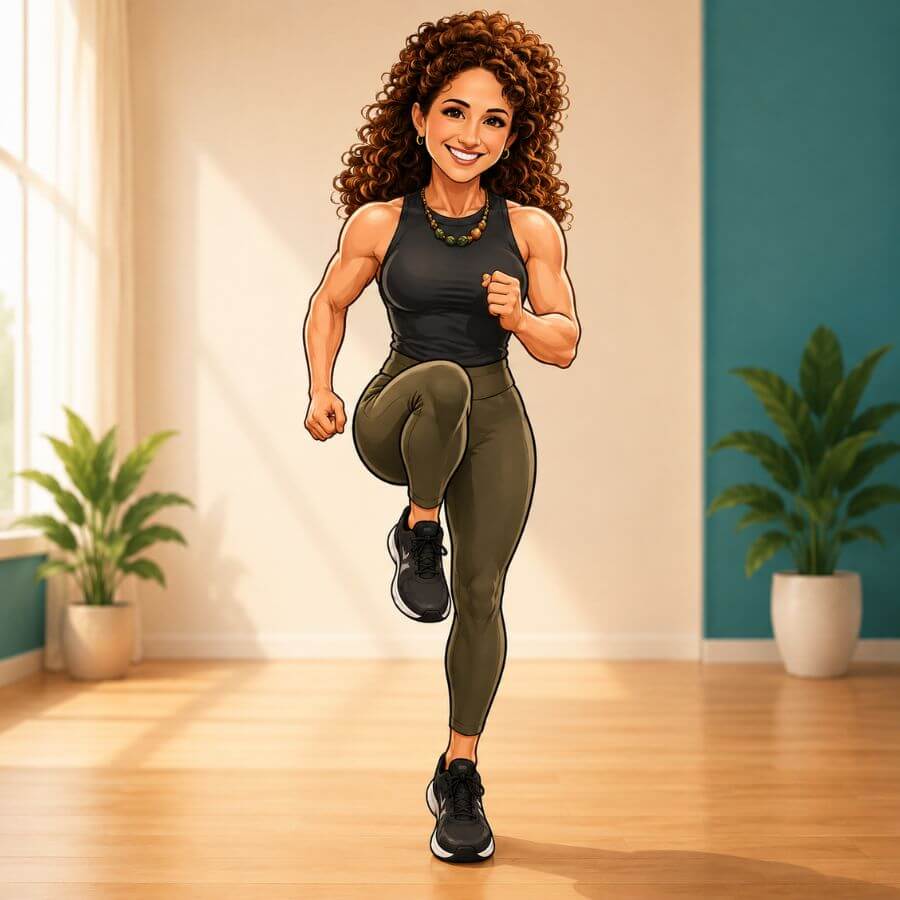
Duration: 30–60 seconds per set, 3–5 sets.
- Keep your chest lifted and core gently engaged.
- Land softly through your feet — no heavy stomping.
- Pump your arms to increase the cardiovascular demand.
- Lift knees higher for more intensity when ready.
For a more challenging version, hold light hand weights or add a knee raise to a slight twist. For a gentler version, keep knees low and focus on steady rhythm.
If you are just starting out, read How to Start Strength Training at Home When You Feel Out of Shape.
4. Low-Impact Dance Cardio
Dance cardio does not require perfect rhythm, fancy choreography, or a mirror. It just requires music you enjoy and a few simple moves you can repeat. This option is especially helpful on days when you feel mentally tired and do not want a structured workout.
Duration: 2–4 songs, 3–5 days per week.
- Pick 3–5 simple moves: step touches, heel taps, gentle grapevines, arm reaches, small squats.
- Play one favorite song and move through the entire song without stopping.
- Keep all movements low-impact — no jumping or high-impact landings.
- Repeat for 2–4 songs if you feel good.
The goal is not to look like anyone else. The goal is to move your body, raise your heart rate, and enjoy it enough to do it again tomorrow.
5. Stationary Bike or Recumbent Bike
If you have access to a stationary bike, it is an excellent low-impact cardio option. It is significantly easier on the joints than running or high-impact aerobics and can be adjusted for any fitness level.
A recumbent bike is especially helpful if you need back support or feel uncomfortable on a standard upright bike — it reclines slightly and puts less stress on the lower back.
Duration: Start with 10–15 minutes and build toward 20–30 minutes at moderate effort.
- Start with light resistance and a comfortable pace.
- Keep your cadence steady before adding resistance.
- Add 30-second faster intervals when you feel ready.
- Aim for a moderate effort — challenging but not breathless.
6. Low-Impact Strength Circuits
Cardio does not always have to look like traditional cardio. A simple strength circuit using low-impact movements can raise your heart rate while simultaneously building muscle — making it one of the most time-efficient options available.
This is one of the biggest advantages of strength training for women over 40: you can build muscle, support your metabolism, and improve cardiovascular conditioning in the same session.
How to do it: Move through each exercise back to back with minimal rest. Rest 60–90 seconds after completing all five, then repeat 2–3 times.
| Exercise Chair Squats | Duration/Reps 12 reps | Tip Lower slowly, press through heels |
| Exercise Wall Push-Ups | Duration/Reps 10 reps | Tip Body in a straight line |
| Exercise Glute Bridges | Duration/Reps 15 reps | Tip Squeeze at the top |
| Exercise Standing Marches | Duration/Reps 45 seconds | Tip Pump arms for more intensity |
| Exercise Step Touches | Duration/Reps 45 seconds | Tip Add arm reaches when ready |
For more bodyweight exercise ideas, read Body Weight Exercises for Women Over 40.
A Simple Low-Impact Cardio Plan for Beginners
You do not need to do all six exercises every day. Pick two or three options you enjoy and rotate them through the week alongside your strength training sessions.
| Monday Strength workout | Tuesday 15–20 min brisk walk | Wednesday Strength workout |
| Thursday Marching + step touches 15 min | Friday Strength workout | Saturday Low-impact dance cardio or bike |
| Sunday Easy walk or full rest | Build consistency first | Start where you are |
For a more complete weekly structure including strength and cardio together, read Balanced Weekly Workout Plan for Women Over 40.
How Hard Should Low-Impact Cardio Feel?
Use the talk test. During moderate cardio you should be able to speak in short sentences but feel like you are genuinely working. If you are gasping, feeling dizzy, or experiencing pain — slow down or stop.
You can also rate your effort on a scale of 1–10. For most low-impact cardio sessions, aim for a 5–7.
- Easy effort (3–4): Warm-up pace, comfortable conversation
- Moderate effort (5–7): Working but sustainable, short sentences
- Hard effort (8–9): Difficult to speak, not sustainable for long
Most beginners get plenty of benefit by building steady, repeatable moderate effort. You do not need to live in the hard zone to improve your fitness significantly.
Starting your day with movement sets a powerful tone — 7 Simple Morning Exercises to Boost Energy and Mobility pairs perfectly with a low-impact cardio routine.
Final Thoughts
Low-impact cardio is not the easy way out. It is the smart way forward for most women over 40.
You can protect your joints, build real endurance, and feel stronger — without punishing your body into submission.
Start small. Stay consistent. Let your confidence and fitness grow one workout at a time.
Want Simple Workouts You Can Actually Stick With?
Strength 4 Life was created for real women who want to get stronger at home without feeling overwhelmed — beginner-friendly, low-impact options included.
- Done-for-you beginner workout plans
- Low-impact cardio and strength options
- Home-friendly routines under 40 minutes
- Supportive guidance from a certified trainer
Frequently Asked Questions
Yes. Low-impact cardio improves endurance, heart health, energy, and daily stamina while being much easier on the joints than high-impact exercise. It is one of the most sustainable forms of cardio for women over 40.
It can contribute significantly, especially when paired with strength training, good nutrition, and consistency. Low-impact cardio burns calories and improves conditioning without requiring extreme or unsustainable workouts.
A good starting point is 2–4 days per week, with strength training on the other days. Start with 10–15 minute sessions and build gradually based on your schedule, recovery, and fitness level.
Walking, stationary biking, and step touches are all excellent options for women with knee sensitivity. These movements keep impact minimal while still elevating the heart rate effectively. Building strength in the glutes and quads through strength training also helps support and protect the knee joint over time.
Walking is an excellent foundation and should not be underestimated — consistent daily walking produces real cardiovascular and metabolic benefits. For most women, combining regular walking with 2–3 strength sessions per week covers the full spectrum of what the body needs after 40.
Fitness Over 40 Resources




Explore More Fitness Over 40 Resources
 Step 1
 Step 2
 Step 3
 Step 4
 Step 5
Ready to put this into action?
💪 Start Your Free 7-Day Trial
Free Home Workout Starter Guide
Download your free PDF and start building strength today.
- 3 beginner-friendly routines
- No equipment needed
- Just 20 minutes a day
Enter your email to download