7 Simple Morning Exercises to Boost Energy and Mobility
📋 Heather is an ISSA Certified Personal Trainer, not a doctor or medical professional. This article is for educational and motivational purposes only. Always check with your healthcare provider before starting a new fitness program.
Some mornings, your body feels ready to move. Other mornings, everything feels stiff, slow, and a little creaky. If that sounds familiar, you are not alone.
A short morning movement routine can help you wake up your body without needing a full workout. You do not need to sweat heavily, change clothes, or carve out an hour. A few simple exercises can help improve circulation, loosen stiff joints, and give you a better start to the day.
Morning exercise does not have to be intense to be useful. For many women, especially after 40, gentle consistency is more helpful than forcing a hard workout before the day even begins.
- You can do these exercises at home.
- You do not need equipment.
- You can finish in about 7 to 12 minutes.
- You can adjust every move to fit your body.
The CDC recommends regular physical activity for adults, including aerobic activity and muscle-strengthening exercise. Short movement breaks can be a helpful way to begin building toward a more active lifestyle. You can read the CDC adult activity guidelines here.

Why Morning Movement Helps
After a night of sleep, your body may feel tight. Your hips, back, shoulders, and neck can all feel stiff when you first get up. Morning movement helps your joints move through a comfortable range of motion before the day starts pulling you in every direction.
It can also help your mind. A short routine gives you a feeling of follow-through early in the day. That matters because confidence often grows from small promises kept.
- Gentle movement can reduce morning stiffness.
- Simple exercises can support mobility and balance.
- A short routine can help improve energy.
- Starting small makes consistency easier.
If you are getting back into exercise after time away, morning movement can be a great first step because it feels doable and low pressure.
1. Shoulder Rolls
Shoulder rolls are a gentle way to loosen your upper back, neck, and shoulders. This is especially helpful if you wake up feeling tense or spend a lot of time sitting during the day.

Stand tall or sit on the edge of a chair. Slowly roll your shoulders up, back, and down. After a few rounds, reverse the direction.
- Do 8 to 10 slow rolls backward.
- Do 8 to 10 slow rolls forward.
- Keep your jaw and neck relaxed.
- Breathe slowly as you move.
2. Standing Side Bends
Standing side bends help wake up the sides of your body, including the ribs, waist, and back. They can feel especially good if you wake up feeling compressed or stiff.
How to do it
Stand with your feet about hip-width apart. Reach one arm overhead and gently lean to the opposite side. Come back to center and repeat on the other side.
- Move slowly from side to side.
- Keep both feet grounded.
- Avoid collapsing forward.
- Do 5 to 8 bends per side.
This is not about forcing a deep stretch. It is about gently creating space and movement.
3. Marching in Place
Marching in place is simple, but it works. It raises your heart rate gently, warms up your hips, and helps your body shift from sleepy to awake.

Stand tall and begin marching at a comfortable pace. Let your arms swing naturally. If you feel good, lift your knees a little higher or add more arm movement.
- March for 30 to 60 seconds.
- Keep your chest lifted.
- Land softly through your feet.
- Use a chair or wall for balance if needed.
For more joint-friendly movement ideas, read: The Best Low-Impact Cardio Exercises for Women Over 40
4. Chair Squats
Chair squats are a great morning exercise because they wake up the legs and glutes without needing any equipment. They also help with a real-life movement you do every day: sitting down and standing up.
Stand in front of a sturdy chair with your feet about hip-width apart. Slowly sit your hips back toward the chair, lightly touch down if needed, then stand back up.
- Keep your chest lifted.
- Press through your heels as you stand.
- Use your arms for balance if needed.
- Start with 6 to 10 repetitions.
If your knees feel sensitive, reduce the depth and move slowly. The goal is control, not speed.
5. Wall Push-Ups
Wall push-ups gently wake up your chest, shoulders, and arms. They are beginner-friendly and easier on the body than floor push-ups.
Place your hands on a wall slightly wider than shoulder-width. Step your feet back a little. Bend your elbows and lower your chest toward the wall, then press yourself back to the starting position.
- Keep your body in a straight line.
- Move with control.
- Start with 6 to 10 repetitions.
- Step farther from the wall to make it harder.
For more beginner upper body ideas, read: Beginner Upper Body Exercises for Women at Home
6. Hip Circles
Hip circles help loosen the hips and lower back. This can be a great move if you wake up feeling stiff through the pelvis, low back, or legs.
Stand with your feet about hip-width apart and place your hands on your hips. Slowly make circles with your hips in one direction, then switch directions.
- Move slowly and gently.
- Keep your knees soft.
- Do 5 to 8 circles each way.
- Make the circles smaller if your back feels tight.
This should feel like you are easing into movement, not forcing your body into a stretch.
7. Standing Reach and Fold
This final movement helps stretch the back of the body and encourages a few deeper breaths. It is a nice way to finish your morning routine.

Reach both arms overhead, take a breath, then slowly hinge forward as far as comfortable. You do not need to touch your toes. Bend your knees as much as needed. Slowly roll or rise back up.
- Move slowly.
- Keep your knees soft.
- Do not force the stretch.
- Repeat 3 to 5 times.
If bending forward does not feel good for your back, place your hands on a counter or chair and do a supported version instead.
A Simple 7-Minute Morning Routine
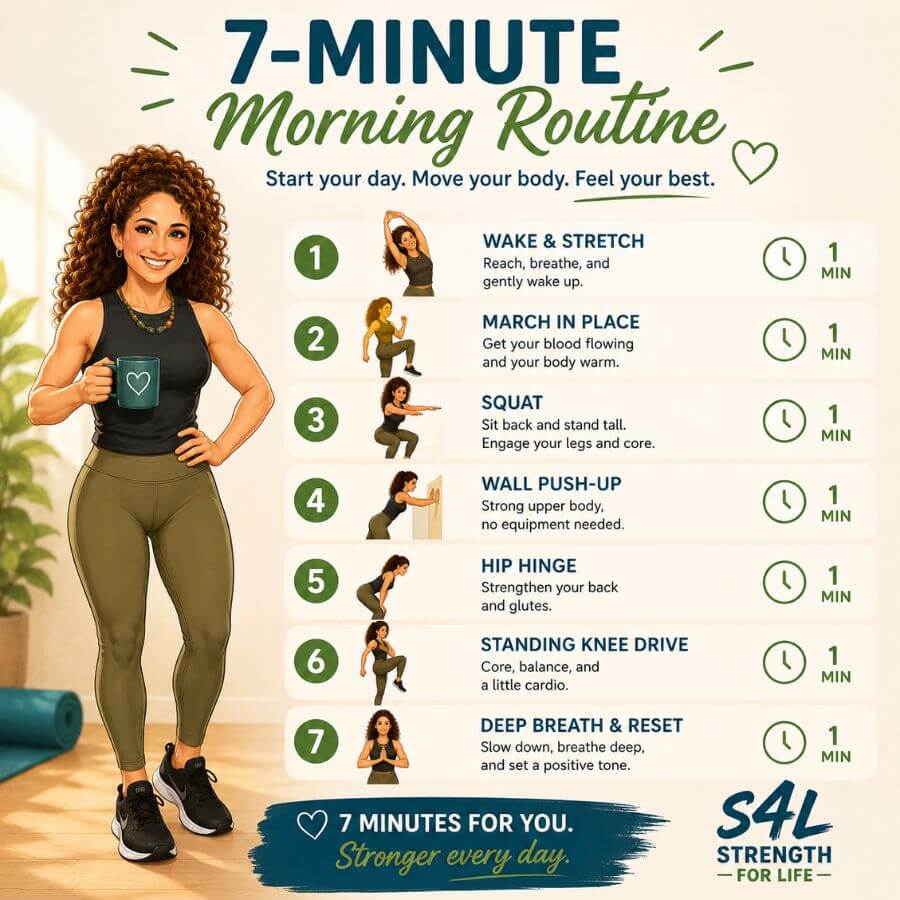
You can use these seven exercises as a quick morning reset. Move at a comfortable pace and rest whenever you need to.
| 1 Minute Shoulder rolls and breathing | 1 Minute Standing side bends | 1 Minute Marching in place |
| 1 Minute Chair squats | 1 Minute Wall push-ups | 1 Minute Hip circles |
| 1 Minute Standing reach and fold | Goal Wake up the body | Reminder Gentle is enough |
How to Make Morning Exercise a Habit
The easiest morning routine is the one you do before the day gets loud. Keep it short, simple, and tied to something you already do.
- Do it after brushing your teeth.
- Keep your mat or shoes visible.
- Start with only 3 exercises if needed.
- Use the same routine for two weeks before changing it.
Consistency gets easier when the routine is small enough to repeat, even on busy mornings.
Should Morning Exercise Replace a Full Workout?
Not always. Think of morning movement as a helpful habit, not a replacement for every workout.
These exercises are great for energy, mobility, and consistency. For building more strength over time, you will still want regular strength workouts during the week.
- Morning movement helps wake up your body.
- Strength training helps build muscle.
- Walking or low-impact cardio supports endurance.
- Recovery helps your body adapt.
If you want a complete weekly plan, read: Balanced Weekly Workout Plan for Women Over 40.
Final Thoughts
You do not need a long workout to start your day well.
A few simple morning exercises can help you feel more awake, mobile, and ready for the day.
Start small. Move gently. Let the routine become one more way you care for yourself.
Want Simple Workouts That Fit Your Life?
Strength 4 Life helps women build strength and confidence at home with beginner-friendly workouts that feel realistic, supportive, and doable.
- Simple home workouts
- Beginner-friendly strength training
- Low-impact options
- Encouraging guidance for real life
Frequently Asked Questions
Yes. Gentle morning exercises can help reduce stiffness, improve mobility, support energy, and make it easier to build a consistent movement habit.
A good morning routine can be as short as 5 to 10 minutes. The goal is to wake up your body, not exhaust yourself before the day begins.
Many people can do gentle movement before breakfast, but listen to your body. If you feel lightheaded or weak, have water and a small snack first.
They can. Gentle movement helps your joints and muscles move after sleep, which may reduce that stiff, slow feeling many people notice in the morning.
Staying Consistent With Exercise Resources





Explore More Fitness Over 40 Resources
 Step 1
 Step 2
 Step 3
 Step 4
 Step 5
Ready to put this into action?
💪 Start Your Free 7-Day Trial
Free Home Workout Starter Guide
Download your free PDF and start building strength today.
- 3 beginner-friendly routines
- No equipment needed
- Just 20 minutes a day
Enter your email to download