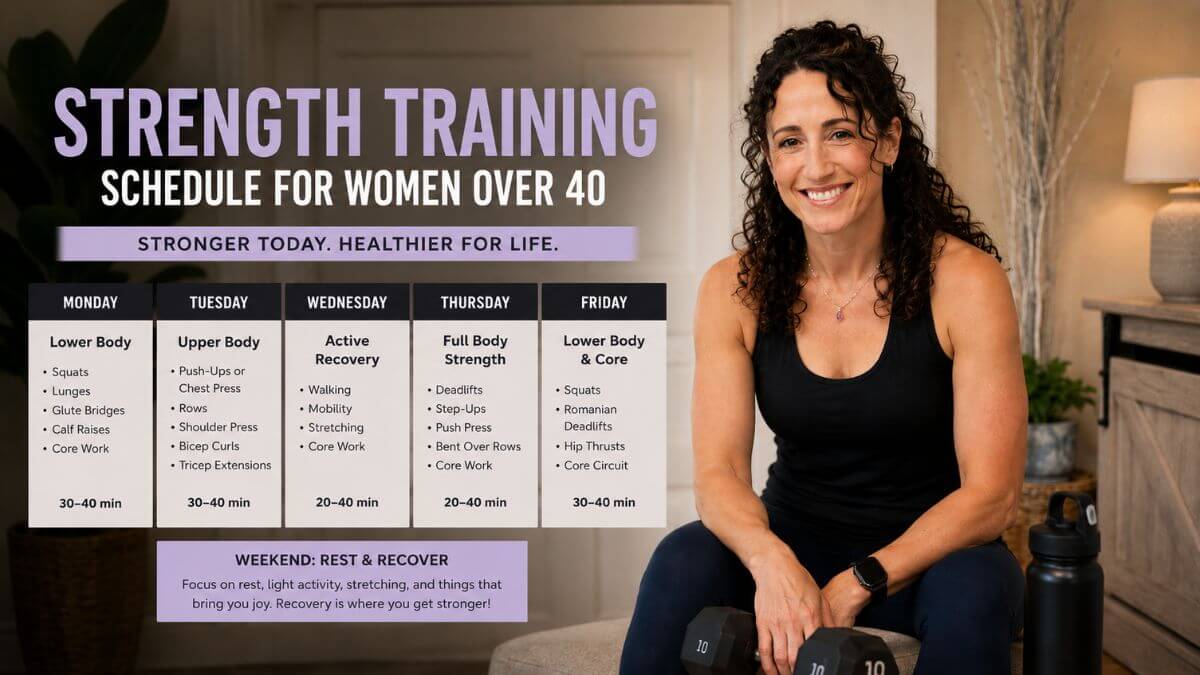
A Realistic Strength Training Schedule for Women Over 40
📋 Heather is an ISSA Certified Personal Trainer, not a doctor or medical professional. This article is for educational and motivational purposes only. Always check with your healthcare provider before starting a new fitness program.
If you’ve ever wondered how often you should work out, which days to train, or whether you’re doing enough — you’re not alone. A realistic strength training schedule for women over 40 should fit into real life, not take it over.
The goal isn’t to spend hours exercising every day. The goal is to build strength, improve energy, and create a routine you can actually maintain month after month — even when life gets busy.
- Train consistently without feeling overwhelmed.
- Build real strength with simple home workouts.
- Allow enough recovery to support progress.
- Create a schedule that works with a busy life.
Many women assume they need to work out five or six days a week to see results. In reality, two to three focused strength workouts per week can be incredibly effective — especially after 40 when recovery becomes more important than volume.
For a deeper look at why building strength matters as we age, read Why Strength Training Gets More Important After 40.

Why a Strength Training Schedule Matters After 40
Random workouts are better than no workouts — but a schedule creates the consistency that produces real results. When you know what days you’re training and what days you’re recovering, fitness becomes part of your routine instead of something you try to squeeze in whenever you find a spare moment.
- A schedule removes daily decision fatigue.
- It helps you stay consistent during busy weeks.
- Recovery becomes part of the plan instead of an afterthought.
- Progress becomes easier to track and build on.
The CDC recommends adults include muscle-strengthening activities at least two days per week. That’s a realistic and achievable starting point for most women over 40.
How Often Should Women Over 40 Strength Train?
Most women over 40 do very well with two to three strength workouts each week. Here’s how to think about which frequency is right for you:
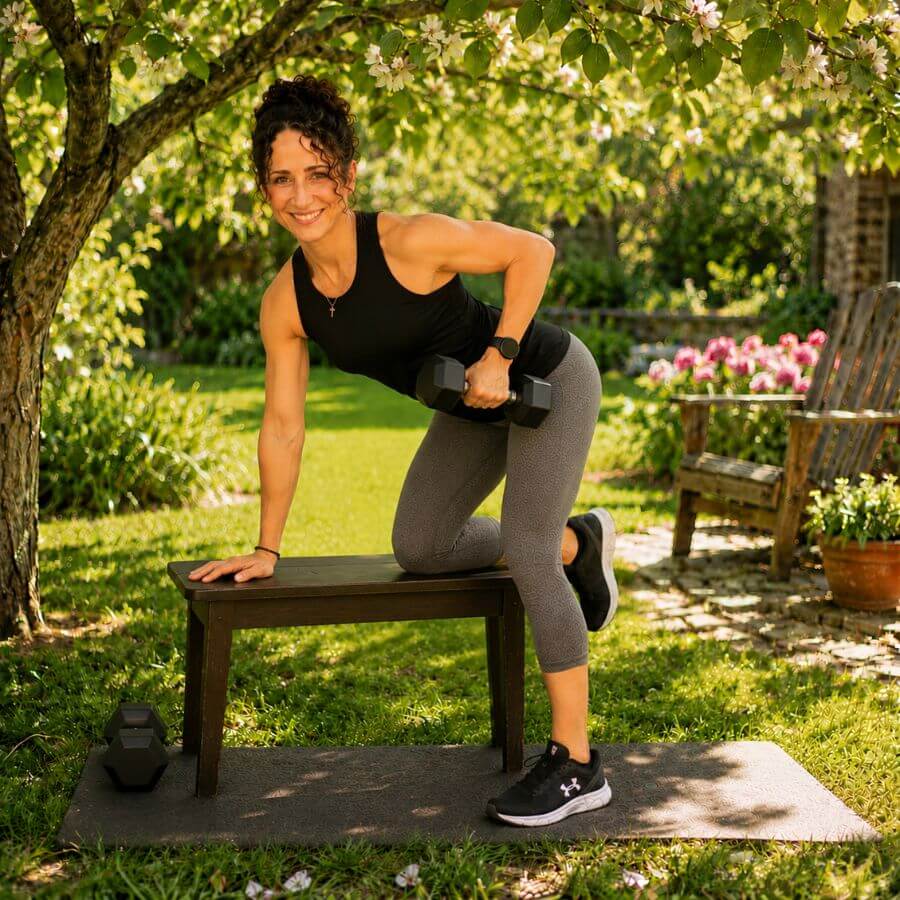
- 2 days per week: Ideal for beginners, very busy schedules, or women returning after a long break. Still produces meaningful strength gains.
- 3 days per week: The sweet spot for most women. Enough volume to build strength steadily while allowing full recovery between sessions.
- 4 days per week: Appropriate for more experienced women who have built a solid base and recover well. Usually unnecessary for beginners.
If you are just getting started, the Simple Strength Plan for Women Over 40 gives you a complete 3-day structure to follow.
Two-Day vs Three-Day Strength Training Schedules
Both approaches work well. The right choice depends on your current fitness level, recovery capacity, and how much time you can consistently commit.

Two Days Per Week
Perfect for beginners and women with demanding schedules. Two full-body strength sessions per week — with walking and rest in between — is enough to build real strength and establish the habit.
| Monday Full-Body Strength | Tuesday Walk or rest | Wednesday Walk or rest |
| Thursday Full-Body Strength | Friday Walk or light movement | Weekend Rest or family activity |
Three Days Per Week
A great option for women who want to build strength steadily while keeping their schedule manageable. Three sessions per week gives you enough training volume to see real progress, with built-in recovery days that your body will thank you for.
| Monday Lower Body + Core | Tuesday Walk or rest | Wednesday Upper Body + Core |
| Thursday Rest or mobility | Friday Full Body | Weekend Walk or recovery |
What Should Each Workout Include?
A well-rounded strength workout should train all the major muscle groups without becoming complicated. Most women over 40 can make excellent progress using a handful of foundational movement patterns repeated consistently.
The five movement patterns every workout should cover:
- Squat variation — chair squats, goblet squats, or bodyweight squats
- Push movement — wall push-ups, incline push-ups, or dumbbell press
- Pull movement — dumbbell rows or resistance band rows
- Glute exercise — glute bridges or Romanian deadlifts
- Core exercise — dead bugs, bird dogs, or plank holds
Sets and reps for beginners: 2–3 sets of 8–12 reps per exercise. Rest 45–60 seconds between sets. Total workout time: 20–35 minutes.
For a complete list of the best exercises to fill each category, read Best Beginner Strength Exercises for Women Over 40.
A Complete Sample Week for Beginners
Here is what a realistic beginner week looks like using the three-day schedule, with specific exercises, sets, and reps for each session.
Monday — Lower Body + Core
| Exercise Chair Squats | Sets × Reps 3 × 10–12 | Tip Lower until you touch the chair |
| Exercise Glute Bridges | Sets × Reps 3 × 12–15 | Tip Squeeze glutes at the top |
| Exercise Reverse Lunges | Sets × Reps 2 × 8 per leg | Tip Hold wall for balance |
| Exercise Dead Bugs | Sets × Reps 2 × 8 per side | Tip Keep lower back pressed down |
Wednesday — Upper Body + Core
| Exercise Wall Push-Ups | Sets × Reps 3 × 10–12 | Tip Body in straight line throughout |
| Exercise Dumbbell Rows | Sets × Reps 3 × 10 per arm | Tip Lead with elbow, not hand |
| Exercise Shoulder Press | Sets × Reps 3 × 10–12 | Tip Start lighter than you think |
| Exercise Bird Dogs | Sets × Reps 2 × 8 per side | Tip Move slowly and controlled |
Friday — Full Body
| Exercise Goblet Squats | Sets × Reps 3 × 10 | Tip Hold dumbbell at chest |
| Exercise Incline Push-Ups | Sets × Reps 3 × 10 | Tip Use countertop or bench |
| Exercise Dumbbell Deadlift | Sets × Reps 3 × 10 | Tip Hinge at hips, keep back flat |
| Exercise Glute Bridges | Sets × Reps 2 × 15 | Tip Add band for more challenge |
| Exercise Plank Hold | Sets × Reps 2 × 20–30 sec | Tip Knees down is perfectly fine |
For a complete beginner walkthrough from scratch, read: Beginner Strength Training for Women: Complete Guide.
Building a Schedule That Actually Fits Your Life
Before choosing exercises, choose your schedule. Look at your week honestly. Which days give you the best chance of success — not the best days in theory, but realistically?
1. Schedule workouts around your life — not the other way around
Many women try to force a fitness plan into a schedule that is already overloaded. Instead, start by identifying two or three days that consistently have a window of 30–40 minutes.
- Choose your workout days first.
- Block them on your calendar like appointments.
- Leave room for flexibility when life gets busy.
- Protect those windows as much as possible.
2. Keep workouts short enough to actually do
A 20-minute workout you complete every week beats a 60-minute workout you skip because it feels too long. Start with sessions you can finish and feel good about — then build from there.
3. Plan your week on Sunday
Take two minutes each Sunday to look at the week ahead and confirm which three days you’re training. Knowing in advance removes the daily decision and makes it far more likely you’ll follow through.
Walking and Cardio Still Matter
A strength training schedule doesn’t mean ignoring cardio. Walking remains one of the best forms of exercise for women over 40 — easy on the joints, good for heart health, helpful for stress management, and a perfect complement to strength training.
- Walk on non-strength training days when possible.
- Aim for 15–30 minutes most days.
- Use walking as active recovery between sessions.
- Choose movement you enjoy and can repeat consistently.
You do not need to choose between strength training and cardio. For most women, the best approach includes both working together.
Starting your day with movement, whether with cardio or strength training can make a real difference — 7 Simple Morning Exercises to Boost Energy and Mobility is a great place to begin.
Recovery Is Part of the Schedule
Many women think progress only happens during workouts. The truth is your body adapts and gets stronger during recovery — not during the training session itself. After 40, this becomes even more important.

- Allow at least one full day between strength sessions.
- Prioritize 7–8 hours of sleep — this is when most muscle repair happens.
- Stay hydrated throughout the day.
- Use mobility work or gentle stretching on rest days.
- Listen to signs of excessive fatigue — they matter more after 40.
Taking recovery seriously is not weakness. It is how you stay consistent for months and years instead of burning out after a few weeks.
What If You Miss a Workout?
Life happens. Schedules change. Kids get sick. Work gets stressful. Missing one workout does not erase your progress — not even close.
- Skip the guilt entirely.
- Do not try to double up to catch up — that usually leads to injury or burnout.
- Resume your normal schedule at the next opportunity.
- Focus on consistency over months, not perfection every single week.
The women who see long-term results are not the ones with perfect attendance. They are the ones who keep returning to the plan after interruptions — without drama, without punishment, without starting over.
If consistency is a real challenge for you, read How to Stay Consistent With Exercise When You’re Tired, Busy, and Overwhelmed.
And if you want to understand the mindset behind pushing through hard days, Why Working Hard Matters in Fitness is worth reading.
Common Scheduling Mistakes to Avoid
A few simple mistakes can make strength training feel harder and less rewarding than it should be.
1. Doing Too Much Too Soon
Starting with an ambitious 5-day plan when your life can realistically support 2-3 days is one of the most common reasons women quit. Begin with a schedule you can maintain for months — not a schedule that impresses you on paper.
2. Training Too Many Days in a Row
Back-to-back strength sessions without recovery days leads to fatigue, soreness, and diminishing returns. Spread your workouts across the week with rest days in between.
3. Skipping Recovery Entirely
Rest days are not lazy days. They are the days your muscles rebuild. Treating them as wasted time is one of the fastest ways to plateau or get injured.
4. Changing the Plan Too Often
Switching workouts every week prevents you from getting better at the movements. Repeat the same exercises for at least 4–6 weeks before changing anything. Progression comes from mastery, not variety.
Final Thoughts
A realistic strength training schedule for women over 40 is not about doing more. It is about doing enough — consistently.
Two or three strength workouts each week, supported by walking, recovery, and simple habits, can build real strength, improve confidence, and make everyday life feel noticeably better.
The best workout schedule is the one you can still follow three months from now.
Ready to Start Building Strength at Home?
Strength 4 Life provides simple home workout programs designed specifically for women who want realistic fitness guidance and sustainable results — no gym, no extreme fitness culture, no guessing about what to do next.
- Done-for-you beginner workout plans
- Low-impact modifications available
- Home-friendly routines under 40 minutes
- Supportive coaching from a certified trainer
Frequently Asked Questions
Two to three strength training sessions per week is ideal for most women over 40. That frequency builds real strength while leaving enough time for recovery between workouts.
Yes. Two well-structured full-body strength workouts per week can produce meaningful and lasting improvements in strength, muscle tone, and overall fitness — especially for beginners.
You can, but most women find it easier and more effective to walk or do low-impact cardio on non-strength training days. That approach keeps each session focused and supports better recovery.
The best schedule is the one that fits your actual life and can be followed consistently over time. For most women that means three strength sessions per week — Monday, Wednesday, and Friday — with walking and rest on the days in between.
20–40 minutes is plenty for a beginner strength workout. You do not need to train for an hour to see results. Shorter sessions done consistently will always outperform longer sessions done occasionally.
Strength Training for Women Over 40 Resources







Explore More Fitness Over 40 Resources
 Step 1
 Step 2
 Step 3
 Step 4
 Step 5
Ready to put this into action?
💪 Start Your Free 7-Day Trial
Free Home Workout Starter Guide
Download your free PDF and start building strength today.
- 3 beginner-friendly routines
- No equipment needed
- Just 20 minutes a day
Enter your email to download